BUSINESS LAW II
CHAPTER 5
CORPORATE DIRECTORS, OFFICERS AND SHAREHOLDERS


I. THE BOARD OF DIRECTORS
A. What is it?
1. The ultimate authority in every corporation.
2. Responsible for all policymaking decisions necessary to manage corporate affairs.
a. Authorize major policy decisions
b. Oversee major negotiations
b.i. Contracts
b.ii. Labor
b.iii. Sale or lease of corporate assets outside regular course of business
b.iv. Dissolution
c. Authorizes pursuit of/retreat from new product lines or business opportunities
3. Responsible for Corporate Officers
a. Who are Officers?
a.i. Executive level employees of corporation
a.i.1. CEO, CFO, COO, CAO, President, VP, etc.
a.ii. Agents of corporation
a.iii. Carry out the directives and delegations of the BOD and Bylaws
a.iv. Manage day to day operations of corporation
b. Select and removes officers – Usually only CEO
c. Determines compensation for officers
d. Supervises Officers – Usually only CEO
4. Make financial decisions
a. Determines capital structure of corporation
a.i. Issuance of shares and bonds
b. Determines whether to declare dividends
B. How does it work?
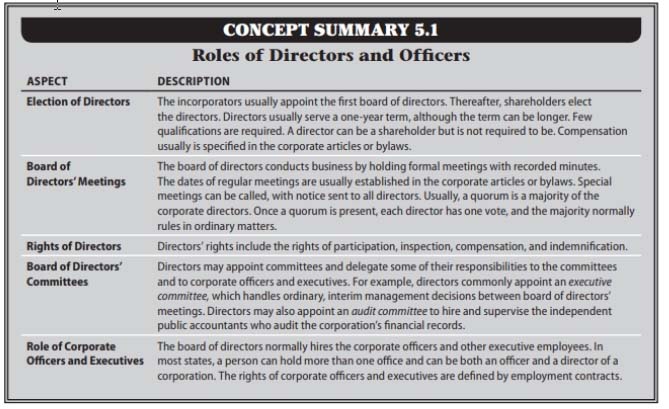
1. As a group, directors collectively control the corporation.
2. Directors must act as a body to carryout routine corporate business.
3. No individual Director can act as agent and bind the corporation.
4. Each Director has one vote and customarily majority wins.
5. The board of directors conducts business by holding formal meetings with recorded minutes.
6. Special meetings can be called with notice sent to all directors.
7. Corporate business matters are presented in the form of resolutions.
8. Resolution – An act of the BOD
9. Quorum of Directors – The minimum number of members of a group that must be present for business to be validly transacted. Usually a majority or other number set by the Articles or Bylaws.
10. Board Committees– When there is a large number of board members they create committees to handle the many issues that confront them.
a. executive committee which handles interim management decisions between board meetings;
b. audit committee which are responsible for the selection, compensation, and oversight of the independent public accountants that audit the firm’s financial records.
c. Others – Finance, Governance, HR/Compensation
C. Who are they?
1. Normally, incorporators appoint the initial board of directors who serve until the first annual meeting.
2. Subsequent directors are elected by majority shareholder vote.
3. The number of directors and their term are established in the Articles or Bylaws.
4. Directors can be removed for cause (for failing to perform as required or specified in the articles or bylaws) or by shareholder action.
D. Rights of Directors
1. Right to participation – right to be notified and to participate in all Board meetings.
2. Right to Inspection –right to access the corporation’s books and records, facilities, and premises.  This right cannot be restricted by the articles, bylaws or any act of the board.
3. Right to Compensation – customarily articles or bylaws authorize compensation.
4. Right to Indemnification – When director is involved in litigation by virtue of their authorized actions or position, they have the right to indemnification (reimbursement) for legal fees and damages incurred.  Normally covered by E&O Insurance.
E. Duties of Directors (SAME AS OFFICERS)
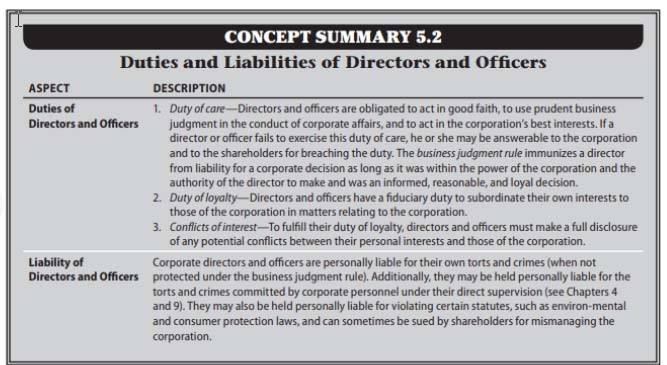
1. The duties of corporate officers and directors are similar because both are involved in decision making and in positions of control.
2. Directors and officers are considered to be fiduciaries (relationship of trust and confidence) of the corporation.
a. owe ethical and legal duties to the corporation and the shareholders in toto.
b. DUTY OF CARE – requires a director or officer to:
i. Act in good faith (honestly).
ii. Do what they believe is in the best interests of the corporation.
iii. Exercise the care that an ordinary prudent (careful) person would exercise in similar circumstances.
iv. Make informed decisions
D.i.1) Attend meetings
D.i.2) Investigate as required
D.i.3) Ask questions
D.i.4) Study issues – May, however, rely in good faith on provided information
v. Exercise a reasonable amount of supervision when they delegate work to corporate officers and employees.
vi. Vote – yay or nay entered into the minutes.
c. DUTY OF LOYALTY
i. Loyalty is defined as faithfulness to one’s obligations and duties.
ii. Requires directors and officers to subordinate their personal interests to the welfare of the corporation.
iii. Cannot use corporate funds or confidential corporate information for personal advantage and must refrain from self-dealing.
iv. Must disclose all CONFLICTS OF INTEREST
D.1) Precluded from entering into or supporting businesses that operate in direct competition with corporations on whose board they serve.
D.2) Their fiduciary duty requires them to make a full disclosure of any potential conflicts of interest that might arise in any corporate transaction, including the nature of the conflicting interest and all facts pertinent to the transaction.
D.3) Usually an annual requirement and as arise
v. Cases dealing with the duty of loyalty typically involve one or more of the following:
1) Competing with the corporation.
2) Usurping (taking personal advantage of) a corporate opportunity.
3) Pursuing an interest that conflicts with that of the corporation.
4) Insider Trading - Using information that is not available to the public to make a profit trading securities.
5) Authorizing a corporate transaction that is detrimental to minority shareholders.
6) Selling control over the corporation.
F. Liability of Directors (AND OFFICERS)
1. Crimes and torts committed by themselves or by corporate employees under their supervision.
2. If shareholders perceive that the corporate directors are not acting in the best interest of the corporation, they may sue the directors in a shareholder’s derivative suit on behalf of the corporation.
3. Illegal Dividends - Dividends paid out of an unauthorized account, or their payment causes the corporation to become insolvent.
3.a. the board of directors can be held personally liable for the amount of the payment
4. Directors and officers can also be held personally liable under a number of statutes such consumer protection or environmental.
5. Negligence in certain circumstances.
5.a. If directors and officers fail to exercise due care and the corporation or its shareholders suffer harm, the directors or officers can be held liable for negligence (unless the business judgment rule applies).
5.b. THE BUSINESS JUDGMENT RULE
a.i. a corporate director or officer will not be liable to the corporation or its shareholders for honest mistakes of judgment and bad business decisions.
a.i.1) Court give significant deference to the decisions of corporate directors and officers
a.i.2) consider the reasonableness of a decision at the time it was made, without the benefit of hindsight.
ii. The business judgment rule will apply as long as the director or officer:
a.i.1) Took reasonable steps to become informed about the matter.
a.i.2) Had a rational basis for their decision.
a.i.3) Did not have a conflict of interest between his or her personal interest and that of the corporation.
iii. Unless there is evidence of bad faith, fraud, or a clear breach of fiduciary duties, most courts will apply the rule and protect directors and officers who make bad business decisions from liability for those choices.
a.i.1) Importance of dissenting votes

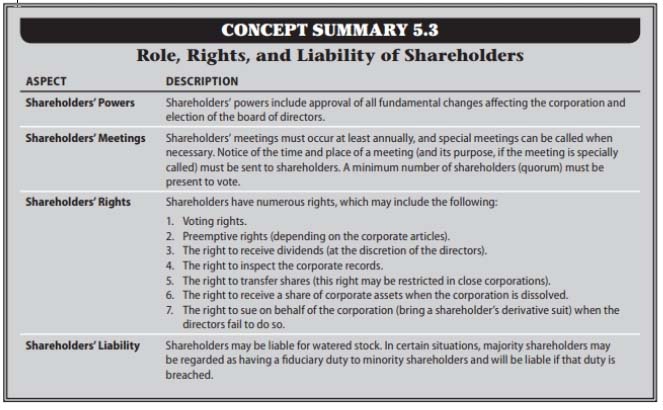
II. SHAREHOLDERS
a.A. Who
a.1. Acquisition of stocks makes a person an owner of and a shareholder in a corporation.
a.2. Stocks are intangible personal property, which gives an equitable interest in the corp, but no legal title to the assets of the corp.
a.3. As a general rule, shareholders have no responsibility for the daily management of the corporation
a.4. ultimately responsible for choosing a board of directors, who are responsible for management.
a.5. vote to elect or remove members of the board of directors for cause (breach of duty or misconduct).
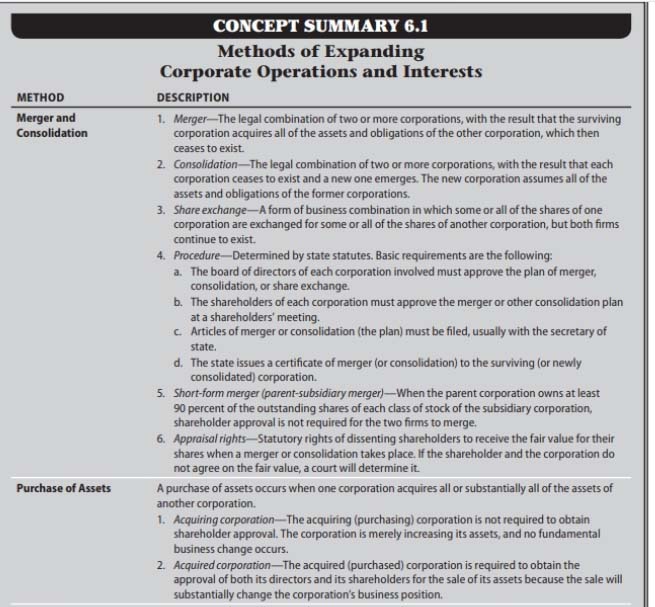
a.6. Shareholders must approve fundamental changes affecting the corporation before the changes can be implemented.
a.6.1.a. to amend the articles of incorporation or bylaws,
a.6.1.b. to conduct a merger or
a.6.1.c. dissolve the corporation, and
a.6.1.d. to sell all or substantially all of the corporation’s assets.
a.B. How it Works
b.i.1. Shareholder Meetings
b.i.1.a. Shareholder meetings must occur at least annually.
b.i.1.b. Special meeting can be called to deal with urgent matters.
b.i.1.c. The corporation must notify shareholders of the date, time, and place of an annual or special shareholders’ meeting, at least ten (10) days, but not more than sixty (60) days, before the meeting date.
b.i.2. Shareholder Voting
b.i.2.a. Shareholders exercise ownership control via the power of their vote.  Corporate business matters are presented in the form of resolutions, which shareholders vote to approve or disapprove.
b.i.2.b. Voting Lists – The corporation prepares voting list before shareholder meetings where only persons whose names appear on the corporation’s stockholder records as owners are entitled to vote.  The voting list contains the name and address of each shareholder as shown on the corporate records on a given cutoff date, or record date.  The list also shows the number of voting shares held by each owner.
b.i.2.c. Quorum Requirements - A quorum exists when shareholders holding more than 50% of the outstanding shares are present, however, the articles or Bylaws may set higher or lower quorum requirements.
b.i.2.d. PROXIES - stockholders may appoint another person as their agent to vote their shares at the annual meeting.  There must be a signed appointment form or electronic transmission authorizing an agent to vote the shares, which is called a proxy.
b.i.2.d.i. usually revocable (can be withdrawn).
b.i.2.d.ii. valid for eleven months, unless the proxy agreement mandates a longer period.
C. Rights of Shareholders
a.i.1. To vote their shares to approve/disapprove fundamental changes affecting corp
a.i.2. To vote on BOD members
a.i.3. Shareholder Proposals – When shareholders (who own at least $1,000.00 worth of stock) want to change corporate policy they can put their ideas up for a shareholder vote by submitting a shareholder proposal to the board of directors.
a.i.4. Pre-emptive Rights – Usually in close corps for purpose of preserving ownership percentage on issuance of additional shares.
a.i.4.a. a shareholder receives a preference or all other purchasers to subscribe to or purchase a prorated share of a new issue of stock, i.e., the shareholder can purchase a percentage of the new shares that is equal to his or her current percentage of ownership in the corporation.
a.i.4.b. Pre-emptive rights do not exist unless provided for in the articles of incorporation and must be exercised within 30-days.
5. Stock Warrants – Sometimes. These are rights to buy stock at a state price by a specified date that are given by the company.  Warrants are often publicly traded on securities exchanges.
6. Dividends – This is a distribution of corporate profits or income ordered by the directors and paid to the shareholders in proportion to their respective shares in the corporation.  Dividends can paid in cash, property, stock of the corporation that is paying the dividends, or stock of other corporations.
a. Depending on state law, dividends may be paid from the following sources:
a.i. Retained Earnings – all states allow dividends to be paid from the undistributed net profits earned by the corporation including capital gains from the sale of fixed assets.
a.ii. Net Profits – A few states allow dividends to be issued from current net profits without regard to deficits in prior years.
a.iii. Surplus – A number of states allow dividends to be paid out of any kind of surplus.
b. Can sue BOD for failure to declare a dividend
7. INSPECTION RIGHTS
a. every shareholder is entitled to examine specified corporate records, including voting lists.
b. The shareholder may inspect in person, or an attorney, accountant, or other authorized assistant as the shareholder’s agent.
c. Proper Purpose – A shareholder only has a right to inspect and copy corporate books and records for a proper purpose, and the request must be made in advance.
d. If the request is denied, the shareholder can appeal to the court.
8. Right to Transfer of Shares – When shares are transferred a new entry is made in the corporate stock book to indicate the new owner. Until notified, and the entry is complete, all rights including voting rights, notice of shareholders’ meetings, and the right to dividend distributions remain with current record owner.
9. RIGHTS ON DISSOLUTION
a. When a corporation is dissolved and all its outstanding debts and the claims of its creditors are satisfied, the remaining assets (if any) are distributed to the shareholders in proportion to the percentage of shares owned by each shareholder.
b. The articles of incorporation may provide that certain classes of preferred stock will be given priority.  If no class of stock has been given preference in the distribution of assets, all of the stockholders share the remaining assets.
10. THE SHAREHOLDER’S DERIVATIVE SUIT – Right to Sue on Corp’s behalf
a. When the corporation is harmed by the actions of third party, the directors can bring a lawsuit in the name of the corporation.
b. If the corporate directors fail to bring a lawsuit, shareholders can do so derivatively
b.i. Prior to bringing the suit, shareholders must make a written demand asking the directors to appropriate action –
b.ii. The directors then have 90 days to act.
b.iii. Only if they refuse can the shareholder bring the lawsuit.
c. Any damages awarded as a result of the suit will go to the corporation.
D. Duties of Majority Shareholders – A majority shareholder is regarded as having a fiduciary duty to the corporation and to minority shareholders.
1. occurs when a single shareholder owns sufficient shares to exercise de facto control over the corporation.
2. When a majority shareholder breaches his or her fiduciary duty to a minority shareholder, the minority shareholder can sue for damages.
E. Liabilities Of Shareholders.
1. Illegal Dividends – Dividends paid out of an unauthorized account, or their payment causes the corporation to become insolvent.
a. shareholders must return illegal dividends only if they knew that the dividends were illegal when the payment was received (or when the corporation was insolvent).
b. Bernie Madoff example
2. WATERED STOCK
a. Watered stock occurs when a corporation issues shares for less than their fair market value.
b. Shareholder personally liable to pay the difference to the corporation
c. Maybe liable to corporate creditors for unpaid debts
|